Comparing several concept routes
The team has a few real routes, but budget and attention only allow one or two to move forward.
Run product concept testing before your team commits R&D, tooling, inventory, or launch budget. NovoChoice uses consumer agents grounded in real signals to compare concept routes, objections, and proof gaps, then turns the evidence into a reviewed decision memo.
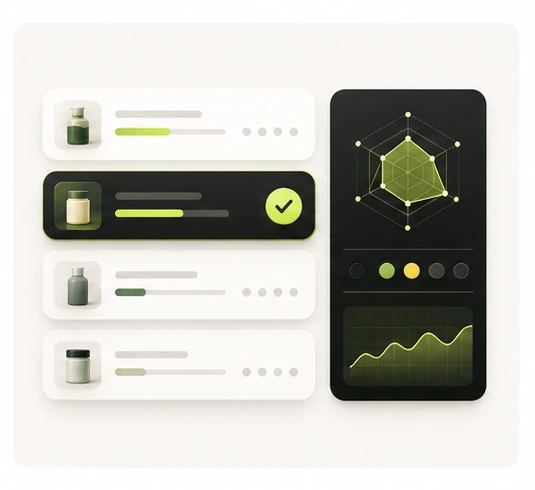
Concept route score
Decision memo
A reviewed recommendation on which concept should advance, be revised, or stop.
Objection signals
Target consumers understood the sensitive-skin use case fastest and asked for fewer clarifying details.
The low-waste route increased brand warmth but did not create enough purchase urgency on its own.
Premium fragrance language triggered price skepticism without stronger proof of performance.
Product concept testing is an early decision method for comparing developed concept routes before a team spends heavily on prototypes, tooling, packaging, inventory, or paid media. It does not claim to prove sales. Its job is to reveal which concept deserves the next real validation step.
Use this when your team already has several real concept routes, but needs to choose what deserves the next investment.
The team has a few real routes, but budget and attention only allow one or two to move forward.
Use it before prototype, sourcing, packaging, inventory, or tooling choices become expensive to reverse.
The readout helps decide what deserves real consumer validation next, and what should be revised or paused.
From a clear decision brief to a reviewed next-step summary.
Clear materials make the review sharper.
From a clear decision brief to a reviewed next-step summary.
Clarify the options, target market, audience assumptions, success criteria, and the decision deadline.
Use consumer agents to compare reactions across segments, objections, use cases, price expectations, and competing alternatives.
Rank concepts by acceptance, clarity, differentiation, trust, premium potential, and execution risk.
Turn the comparison into a recommendation, evidence summary, risk notes, and next validation plan.
A practical readout for the next product review.
A reviewed recommendation on which concept should advance, be revised, or stop.
The likely reasons consumers hesitate, including price, proof, relevance, or complexity.
Recommended next test: prototype, claim rewrite, packaging route, price test, or stop.
Use the readout to choose the next validation step. Do not treat it as demand proof, legal proof, or a sales forecast.
It does not replace a final survey, in-market test, or sales forecast.
Claims, regulated wording, and substantiation still need the right review outside NovoChoice.
Use the readout to sharpen the next validation step, not to claim a representative market result.
Answers before you scope a pilot.
Use it to narrow options and plan sharper real-world validation, not to skip research entirely.
A focused pilot usually compares 3-6 concepts so the output remains actionable.
Product, innovation, founder-led, insights, brand, and growth teams preparing a consumer-product launch.
Run it before prototype lock, packaging design, sourcing, inventory commitment, or creative production, when changing direction is still cheap.
Clear concept descriptions, target segment assumptions, price range, channel context, competitor examples, and the exact decision deadline make the consumer intelligence review sharper.
Share the concepts, target market, timing, and the next decision your team needs to make. NovoChoice will scope whether a private pilot is useful.
Explore adjacent use cases and the product capability behind the readout.
Use this first when the team still has many rough ideas and needs to choose which routes deserve concept testing.
How NovoChoice uses reusable agents grounded in real evidence.
The broader platform layer behind concept, claim, pack, and listing decisions.